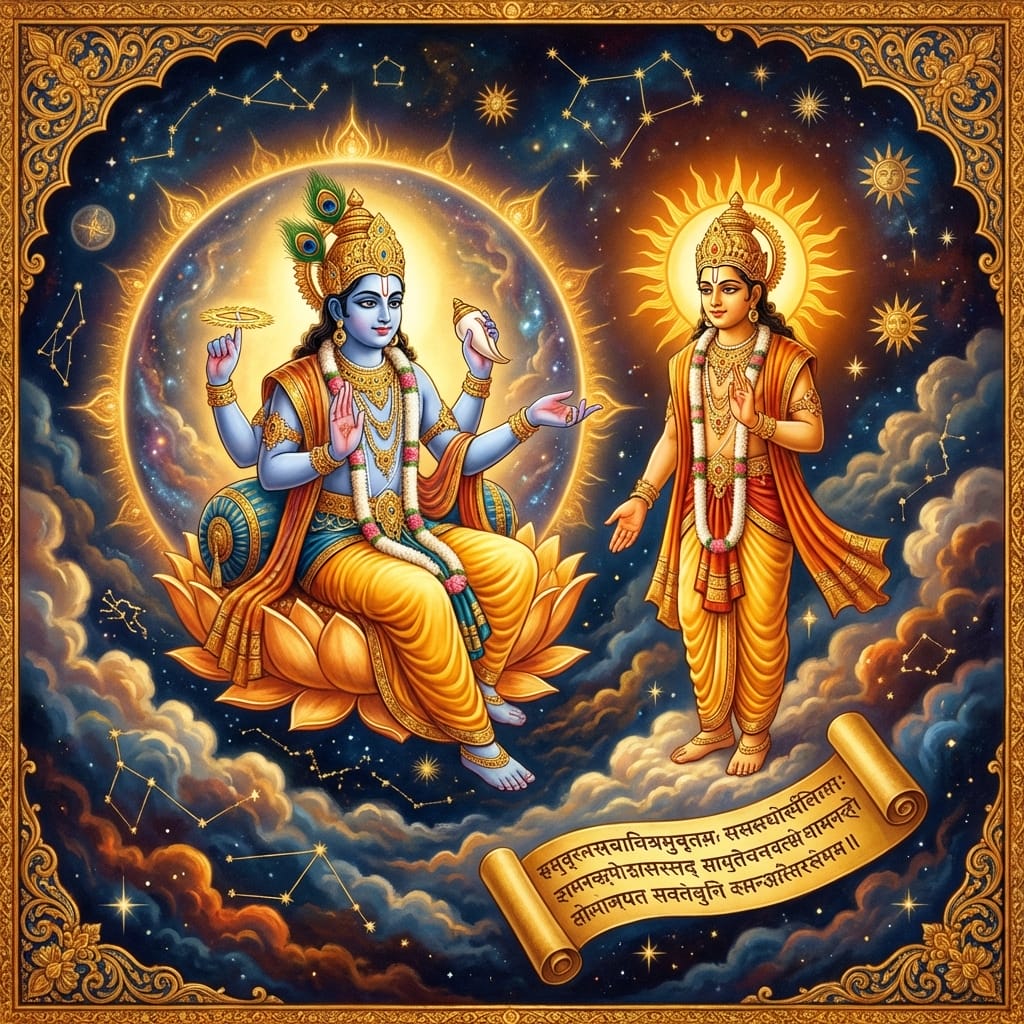
About Bhagavad Gita Chapter 2 - Sankhya Yoga
Bhagavad Gita Chapter 2 - Sankhya Yoga के बारे में
Sankhya Yoga is often pivotal as it contains the essence of the entire Gita. Seeing Arjuna in tears, Lord Krishna rebukes his despondency as unbecoming of a warrior. Arjuna then surrenders to Krishna as his disciple, asking for guidance.
Krishna begins by teaching the highest philosophy: the immortality of the soul (Atman). He explains that the physical body is temporary, like clothes that are changed, but the soul is eternal, indestructible, and beyond birth and death. Therefore, grieving for the physical body is wise.
He then transitions to the practical application of this knowledge: Karma Yoga. He instills the importance of performing one's duty (Dharma) without attachment to the results (Nishkama Karma). He describes the qualities of a person of steady wisdom (Sthita-prajna), one who remains balanced in success and failure.
Wisdom of the Ages
युगों का ज्ञान
This chapter summarizes Vedic philosophy, moving from the analytical knowledge (Sankhya) of the soul to the yoga of action (Buddhi Yoga). It bridges the gap between metaphysical reality and practical daily life. The description of the 'Sthita-prajna' (one of steady wisdom) is considered one of the most beautiful passages in spiritual literature.
Lessons from Chapter 2
अध्याय 2 से शिक्षा
Immortality of the Soul
आत्मा की अमरता
The soul is never born and never dies. Weapons cannot cut it, fire cannot burn it, water cannot wet it, wind cannot dry it.
Duty over Outcome
कर्म ही अधिकार है
You have a right to your prescribed duties, but you are not entitled to the fruits of your actions.
Equanimity
समभाव
Yoga is defined as equanimity (Samatvam) – maintaining balance in pleasure and pain, gain and loss, victory and defeat.
Life Lessons for You
जीवन की सीख
Focus on Process, Not Result
Anxiety often comes from worrying about "What if I fail?" Krishna teaches us to focus entirely on the effort (the input) and let go of the obsession with the outcome. This reduces stress and improves performance.
Emotional Resilience
The concept of Sthita-prajna teaches us to be emotionally stable. Winning shouldn't make us arrogant, and losing shouldn't make us depressed. Maintaining a balanced mind leads to peace.
Key Shlokas
मुख्य श्लोक
Why It Matters
यह महत्वपूर्ण क्यों है
Contains the core philosophy of Atman (Soul) and Karma Yoga.
Defines "Yoga" for the first time in the text.
Provides the description of an enlightened person to emulate.
What's Inside
इसमें क्या है
- Distinction between body and soul
- Concept of Reincarnation
- Philosophy of Selfless Action (Karma Yoga)
- Characteristics of an Enlightened Sage (Sthita-prajna)