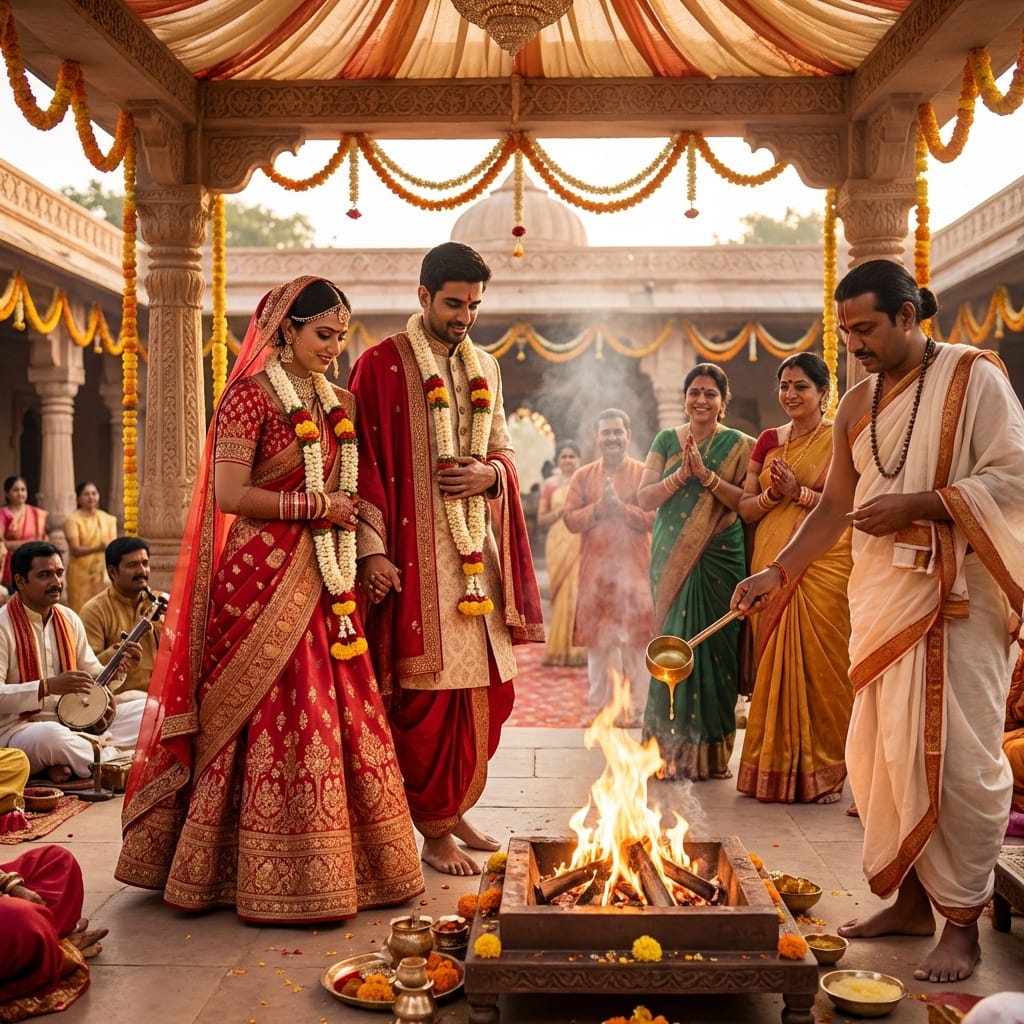
About Samavartana Sanskar - Hindu Graduation Convocation Ceremony Guide
Samavartana Sanskar - Hindu Graduation Convocation Ceremony Guide के बारे में
Samavartana Sanskar (समावर्तन संस्कार), also called Snaatak or Graduation Ceremony, is the fourteenth Sanskar marking the completion of formal education and the student's return home from the Gurukul. It concludes the Brahmacharya (student) Ashram and prepares the individual for Grihastha (householder) Ashram.
The word "Samavartana" comes from "Sam" (completely) and "Avartana" (returning), meaning "returning back" - the student returns home after completing their education under the guru's guidance. This is the ancient equivalent of modern graduation/convocation ceremonies.
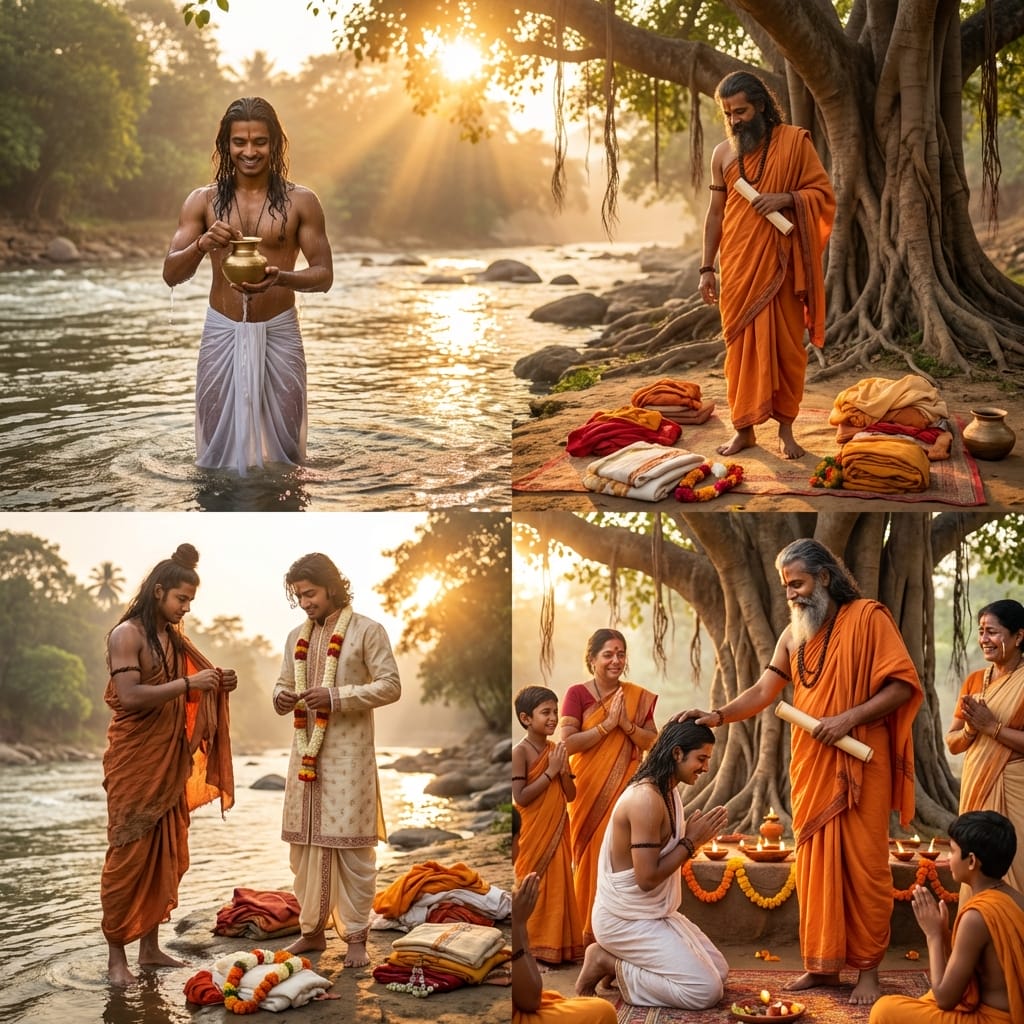
The ceremony involves ritual bathing (calling the graduate "Snaatak" - one who has bathed), wearing fine clothes (transitioning from simple student garments), guru's final teachings and blessings, offering guru dakshina (payment/gifts), and being received home with honor by parents and community.
Samavartana celebrates not just academic achievement but character development—the student has learned self-discipline, knowledge, and values. They're now ready to apply this learning in worldly life, marry, earn livelihood, and contribute to society while continuing spiritual growth.
In modern context, Samavartana beautifully aligns with university graduation ceremonies. Families increasingly perform it alongside or after college convocations, honoring both traditional and contemporary educational completions.
Science & Ayurveda Behind Samavartana
वैज्ञानिक और आयुर्वेदिक आधार
The graduation ceremony has profound psychological benefits:
Transition Psychology: Major life transitions benefit from ritualized closure. Samavartana provides ceremonial completion of studenthood, helping the brain process the transition to new life stage (marriage, career).
Brain Maturation (Early 20s): The prefrontal cortex fully matures around age 25. Samavartana's typical age (18-25) marks when young adults develop full capacity for mature decision-making, planning, and impulse control—readiness for householder life.
Achievement Recognition: Neuroscience shows that recognition and celebration release dopamine, reinforcing the value of long-term effort and study. This creates positive associations with learning and achievement.
Guru Dakshina & Gratitude: Offering gifts to the teacher cultivates gratitude—a psychological state linked to increased happiness, stronger relationships, and better mental health.
Bathhouse Ritual & Fresh Start: The ritual bath symbolizes cleansing and new beginning. Psychologically, symbolic acts help individuals mentally "reset" and embrace new identities.
Returning Home as "Snaatak": The transformed status (from student to graduate) provides clear role transition. Identity theory shows that clear role definitions reduce anxiety and improve adjustment.
Marriage Readiness: Samavartana's timing prepares graduates for marriage. Research shows that completing education before marriage correlates with higher relationship satisfaction and stability.
Community Reintegration: The public ceremony reintegrates the student into community with honor, strengthening social bonds and establishing adult status.
From Gurukul to Grihastha
गुरुकुल से गृहस्थ तक
After 12-20 years in the Gurukul (residential school), the student completed their education—Vedic scriptures, philosophy, mathematics, astronomy, warfare (for Kshatriyas), arts, and life skills. Samavartana marked this momentous transition.
The Snaatak title (graduate) was prestigious. It signified the person was now educated, cultured, ready for societal responsibilities. They had transformed from a child into a knowledgeable, disciplined adult capable of independent thinking and dharmic living.
The Guru Dakshina ritual was profound—the student offered payment/gifts as gratitude for years of free education and parental care from the guru. Some famous stories (like Ekalavya's thumb) illustrate how sacred this final offering was. The guru would bless the student for success in worldly life.
Returning home was celebratory—parents hadn't seen their child (who left at ~8) for over a decade! The young adult returning was transformed, educated, mature. Families welcomed them with pride, and soon marriage arrangements would begin.
Ancient texts describe elaborate Samavartana ceremonies with processions, gifting, community feasts—very similar to modern graduations with caps, gowns, ceremonies, and celebrations recognizing educational achievement.
Samavartana Ceremony Elements
समावर्तन के तत्व
Snaan (Ceremonial Bath)
स्नान
The graduate takes elaborate ceremonial bath with sacred substances. This purification marks the transition from simple student life to the complexities of worldly existence. Hence the name "Snaatak" (one who has bathed).
Guru Dakshina
गुरु दक्षिणा
Student offers payment/gifts to guru as gratitude for years of education. Traditional offerings: gold, cows, land, or service. Modern: monetary gifts, donations. Guru's acceptance blesses the student's future.
Guru's Final Teachings
गुरु का अंतिम उपदेश
Guru imparts final wisdom for worldly life: conduct in society, marriage duties, earning righteously, maintaining spiritual practice amid material life, honoring parents and teachers always.
Home Welcome & Celebration
घर स्वागत
Parents and community receive the graduate with honor. Festive welcome, new clothes, feast. Recognition of the educated, mature individual ready to contribute to society.
Samavartana Ritual Steps
समावर्तन विधि चरण
Why It Matters
यह महत्वपूर्ण क्यों है
Educational Completion – Formally marks the end of student life and beginning of adult responsibilities.
Ashram Transition – Facilitates smooth transition from Brahmacharya (student) to Grihastha (householder) life stage.
Guru Honoring – Provides formal occasion to express gratitude and respect to teachers who shaped one's character.
Social Recognition – Community acknowledges the graduate's readiness to contribute to society with their knowledge.
Confidence Building – The ceremony affirms the individual's capabilities and readiness for independent life.
Closure & New Beginning – Provides psychological closure to student phase while excited embarking on career/marriage.
What's Inside
इसमें क्या है
- Complete Ceremony Guide – Step-by-step Samavartana process
- Guru Dakshina Tradition – What to offer and significance
- Modern Adaptation – Combining with university graduation
- Final Teachings – Wisdom traditionally imparted by gurus
- Snaatak Significance – Meaning of the graduate title
- Transitioning Mindset – From student to householder preparation
- Regional Variations – Different community practices
Frequently Asked Questions
अक्सर पूछे जाने वाले प्रश्न
Can Samavartana be performed alongside modern graduation?
Absolutely! Many families perform Samavartana coinciding with university graduation—either the same day or within the graduation week. The religious ceremony (puja, guru blessings, traditional rituals) happens at home/temple, followed by or preceding the university convocation. This honors both ancient and modern educational traditions. Some incorporate elements into graduation parties. The combination beautifully bridges heritage and contemporary achievement.
Who serves as the "guru" if one didn't study in a traditional Gurukul?
For modern Samavartana, "guru" can be: a respected teacher/professor who significantly impacted you, family priest who guided spiritual learning, or parents themselves (first teachers). Some invite retired teachers or mentors to the ceremony for blessings. The essence is honoring those who contributed to your education and character development. University advisors, thesis supervisors, or beloved school teachers are appropriate modern equivalents.
What is appropriate Guru Dakshina in modern times?
Modern Guru Dakshina can be: monetary gift (based on capacity), donation to teacher's preferred charity in their name, thoughtful gifts reflecting their interests (books, traditional items), funding scholarship in teacher's name, or offering professional service if relevant. For family priest: traditional cash, clothes, grains. For parents (as first gurus): symbolic offering, promise of lifelong respect, care in their old age. Intent matters more than amount—genuine gratitude expressed thoughtfully.
Is Samavartana performed for girls graduating too?
Absolutely yes! While historically male-centric due to Gurukul access, modern understanding recognizes educational completion deserves celebration regardless of gender. Progressive families perform full Samavartana for daughters graduating college/university. The rituals remain the same—ceremonial bath, new clothes, blessings, guru dakshina. As women's education became universal, Samavartana naturally extended to honor all graduates equally.
What final teachings do gurus traditionally impart?
Traditional Guru Updesh (final teaching) includes: Speak truth, practice dharma, don't neglect study (learning continues), honor parents and teachers, marry appropriately, earn/spend righteously, be generous, perform daily rituals, serve society, protect the weak, control senses, never abandon knowledge pursuit, raise children with values. These timeless principles guide the graduate's transition from protected student life to complex adult world.
After Samavartana, what comes next?
Traditionally, the graduate enters Grihastha Ashram (householder stage) through marriage (Vivaha Sanskar—15th Sanskar follows shortly). They begin career, earn livelihood, marry, raise family—applying their education practically while supporting parents, teachers, and society. Modern graduates may delay marriage, pursue higher education, build careers first. But the transition's essence remains: from learning to doing, from receiving to giving, from dependent student to contributing adult member of society.
Scientific References & Citations
- Emerging Adulthood Theory — American Psychological Association (APA)
- Psychological Impact of Graduation Rituals — Journal of Ritual Studies