About Vivaha Sanskar - Hindu Marriage Wedding Ceremony Complete Guide
Vivaha Sanskar - Hindu Marriage Wedding Ceremony Complete Guide के बारे में
Vivaha Sanskar (विवाह संस्कार), the Hindu Marriage Ceremony, is the fifteenth and perhaps most celebrated of the 16 Shodasha Sanskars. More than a social contract, Vivaha is a sacred spiritual bond uniting two souls for a journey of mutual growth, dharma, and spiritual evolution through multiple lifetimes.
The word "Vivaha" comes from "Vivaah" meaning to carry or bear (responsibilities together). Hindu marriage is not just between two individuals but between two families, two lineages, creating a new unit that contributes to society and continues the cycle of dharma.
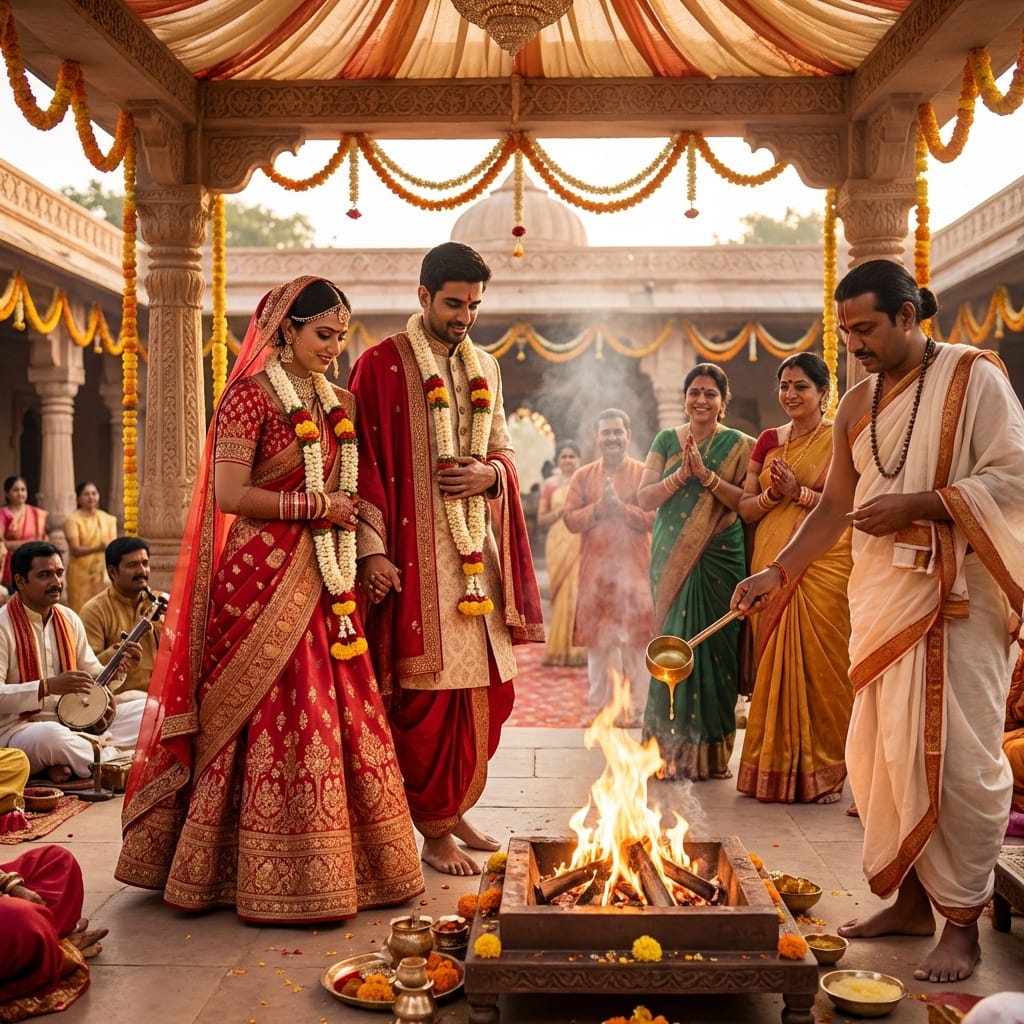
The ceremony centers around the Saptapadi (Seven Steps) - the bride and groom take seven steps around the sacred fire (Agni), each step representing a vow for their life together: nourishment, strength, prosperity, happiness, progeny, harmony through seasons, and lifelong friendship. The Agni (fire) serves as the divine witness to these sacred promises.
Other essential rituals include: Kanyadaan (giving away the bride by her father), Mangalsutra (sacred necklace tying), Sindoor (vermillion applying), exchanging garlands, and circumambulating the fire. Each ritual carries deep symbolic meaning about the roles, responsibilities, and spiritual nature of the marital bond.
Hindu weddings vary dramatically across regions - from elaborate multi-day North Indian celebrations to simpler South Indian rituals, from Bengali Shubho Drishti to Maharashtrian Antarpat. Yet the core elements—fire worship, seven vows, and divine blessings—remain universal, making Vivaha one of the most beautiful and meaningful ceremonies in world culture.
Science & Ayurveda Behind Vivaha
वैज्ञानिक और आयुर्वेदिक आधार
The marriage rituals have deep psychological and physiological effects:
Oxytocin & Bonding: The rituals of touching, holding hands (Panigrahana), and close proximity stimulate oxytocin ('love hormone') release, fostering immediate bonding and trust between partners.
Commitment Psychology: Research shows that public vows (Saptapadi) made before witnesses (Agni, family) create a stronger psychological commitment than private agreements. The 7 steps reinforce specific, actionable goals for marital success.
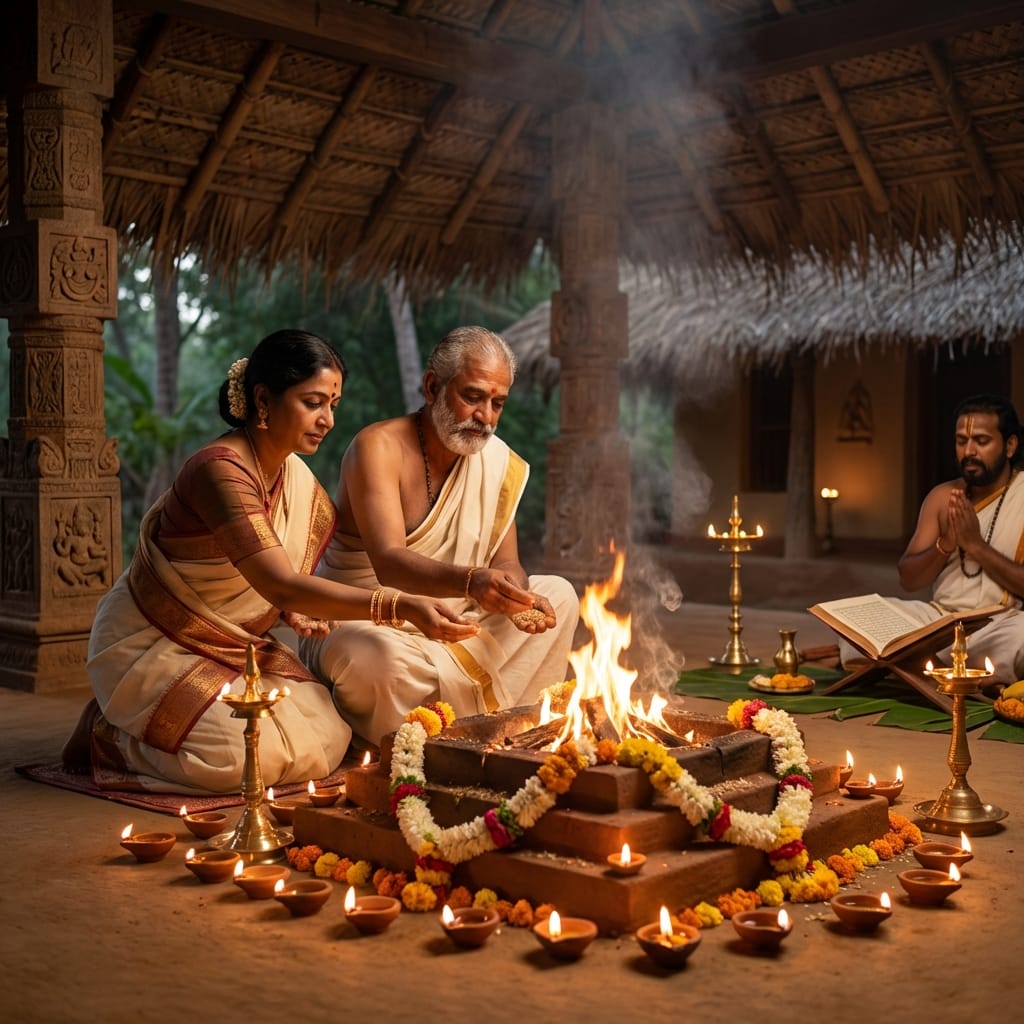
Fire Ritual (Homa) Effects: The smoke from the Homa often contains medicinal herbs (Havant Samagri) which purify the air and have a calming, anti-microbial effect on the environment, setting a pure atmosphere.
Social Stabilization: Formal marriage creates a stable social unit. Sociology confirms that clear social recognition of the couple reduces ambiguity and integrates them into the community support structure.
Joint Decision Making: The vow of 'Sahadharma' (shared duties) sets the precedent for equal partnership, which psychology identifies as a key predictor of marital satisfaction.
Sacred Institution & Eight Forms of Marriage
पवित्र संस्था और विवाह के आठ प्रकार
Ancient Hindu texts describe eight forms of marriage (Ashtavidha Vivaha), though only one—Brahma Vivaha (arranged with mutual consent based on compatibility)—is considered ideal and practiced today. The other seven included love marriages (Gandharva), marriages after conquest (Rakshas), and others, some now considered archaic or unethical.
The Vedic marriage emphasized partnership and equality. Famous Vedic hymns show wives participating in sacrificial rituals alongside husbands. The concept of Ardhangini (better half) signified that neither partner is complete without the other—together they form a complete whole.
The Grihastha Ashram (household stage) begins with Vivaha. It's considered the most important of the four life stages because householders support all others—students, sages, and renunciates. Marriage enables fulfilling three of the four life goals: Dharma (righteous living), Artha (prosperity), and Kama (legitimate desires), preparing one eventually for Moksha (liberation).
Seven lifetimes bond: Traditional belief holds that marriage bonds transcend one lifetime. The seven steps create a connection for seven births, which is why divorce was historically rare and considered breaking a cosmic covenant.
Regional variations reflect India's diversity:
- North India: Mehendi, Sangeet, Baraat (groom's procession), Joota Chupai (shoe hiding)
- South India: Kashi Yatra (mock renunciation), Oonjal (swing ceremony), Talambralu (rice throwing)
- Bengal: Bor Jatri, Subho Drishti (first sight), Mala Badal (garland exchange)
- Maharashtra: Antarpat (cloth barrier), Kanyadaan on wooden plank
Despite variations, the sanctity of Saptapadi before Agni makes the marriage legally and spiritually binding across all Hindu traditions.
Essential Vivaha Rituals
विवाह की मुख्य विधियाँ
Kanyadaan (Giving Away)
कन्यादान
Father places daughter's hand in groom's hand, entrusting her care and happiness to him. Considered one of the highest acts of charity (daan). The groom accepts the sacred responsibility of her welfare and spiritual partnership.
Saptapadi (Seven Steps)
सप्तपदी
The couple takes seven steps around the sacred fire, each with a specific vow: food, strength, wealth, happiness, children, seasons, friendship. After the seventh step, they are legally and spiritually married. This is the ceremony's climax.
Mangalsutra & Sindoor
मंगलसूत्र और सिंदूर
Groom ties the sacred necklace (Mangalsutra) around bride's neck and applies vermillion (Sindoor) in her hair parting. These are visible symbols of married status and commit ment, worn for life by the wife.
Agni Sakshi (Fire Witness)
अग्नि साक्षी
All vows are made before the sacred fire, considered the purest witness. Agni conveys the couple's promises to all deities and the universe, making the bond cosmic and eternal, not just legal or social.
Vivaha Ceremony Steps
विवाह समारोह चरण
Why It Matters
यह महत्वपूर्ण क्यों है
Spiritual Partnership – Marriage creates a sacred bond for mutual spiritual evolution through dharma, artha, kama, eventually leading to moksha.
Social Foundation – The married couple becomes the fundamental unit of society, contributing to community stability and generational continuity.
Grihastha Ashram – Enables entry into householder stage, considered most important as it supports all other life stages (students, renouncers).
Completion of Self – The concept of Ardhangini/Ardhanga (better half) emphasizes that partners complete each other spiritually.
Karmic Bond – Believed to unite souls for multiple lifetimes, making it a cosmic commitment transcending one lifetime.
Dharmic Living – Partnership in fulfilling duties, raising children, serving society, and pursuing righteous life together.
What's Inside
इसमें क्या है
- Complete Ceremony Guide – Detailed step-by-step Hindu wedding process
- Saptapadi Vows Explained – Translation and meaning of each of the seven steps
- Regional Variations – North vs South, Bengali, Maharashtrian, Punjabi customs
- Pre-Wedding Rituals – Mehendi, Sangeet, Haldi, Tilak explained
- Mangalsutra Significance – Why black beads, gold, worn for life
- Modern Adaptations – Shorter ceremonies, outdoor venues, fusion weddings
- Legal Requirements – How Hindu marriage is legally recognized
Frequently Asked Questions
अक्सर पूछे जाने वाले प्रश्न
What makes a Hindu marriage legally valid?
The **Saptapadi** (seven steps around fire) is the defining moment. Once the seventh step is completed, the marriage becomes legally and spiritually binding according to Hindu Marriage Act, 1955. Additionally, the marriage should be: between Hindus over 18/21 years (bride/groom), performed with proper Vedic rites, voluntary consent of both parties, and ideally registered with authorities. The mere performance of Saptapadi before witnesses makes it valid, even without registration.
Can Hindu weddings be performed outside temples?
Absolutely! Hindu weddings traditionally occurred at the bride's home or a dedicated venue, not necessarily temples. The essential requirement is a **sacred fire (Agni)** and proper Vedic rituals performed by a priest. Modern weddings happen in: banquet halls, gardens, beaches, destination locations, or homes. As long as the core rituals (especially Saptpadi) are properly performed with Agni as witness, the location doesn't affect validity.
What is the significance of the seven vows (Saptapadi)?
Each of the seven steps represents a specific vow for the marriage: 1) **Food** - support each other's nourishment, 2) **Strength** - physical and moral strength together, 3) **Prosperity** - earning and managing wealth, 4) **Happiness** - sharing joys and sorrows, 5) **Children** - raising virtuous progeny, 6) **Seasons** - being together through all life phases, 7) **Friendship** - being lifelong companions. These create a comprehensive framework for successful married life covering all aspects.
Why is Kanyadaan considered the most important daan (charity)?
Kanyadaan is considered the highest form of charity because the father is entrusting his most precious treasure—his daughter—to another's care. It's seen as giving away a part of himself, his lineage's future, with complete faith. The groom receives this responsibility sacredly, promising to honor, protect, and enable her spiritual growth. It represents the ultimate trust and transition, blessing both families. Scriptures say Kanyadaan grants immense spiritual merit to the father.
Do bride and groom need to fast before the wedding?
This varies by region and family tradition. Many couples observe a partial fast (avoiding heavy foods, eating only once) on the wedding day until the ceremony completes, believing it purifies them for the sacred ritual. Some communities prescribe specific fasts. Others don't require fasting. The purpose, when observed, is mental clarity, spiritual readiness, and symbolic purity. Always prioritize health—if fasting causes weakness during the lengthy ceremony, eat lightly instead.
Can interfaith or inter-caste marriages be performed as Hindu weddings?
Inter-caste: Absolutely yes! Hindu marriage rituals don't restrict caste mixing. Core rituals remain the same. Interfaith: More complex. If partner converts to Hinduism or the couple agrees to Hindu ceremony, it can be performed. Some progressive priests perform interfaith ceremonies adapting rituals for inclusivity. Legally in India, couples can marry under Special Marriage Act (secular) if Hindu ceremony isn't feasible. Many couples choose dual ceremonies honoring both faiths.
Scientific References & Citations
- Oxytocin and Social Bonding — Harvard Medical School
- Psychology of Commitment and Rituals — SAGE Journals