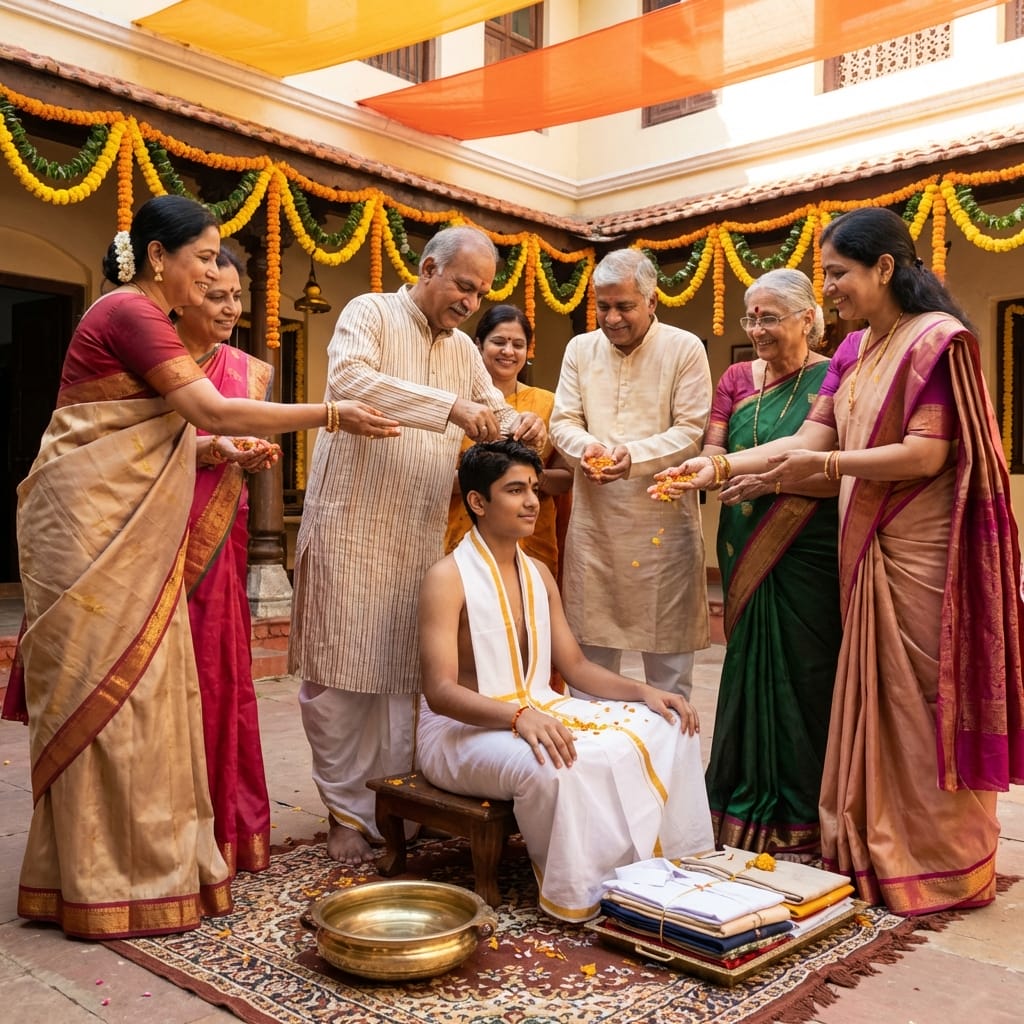
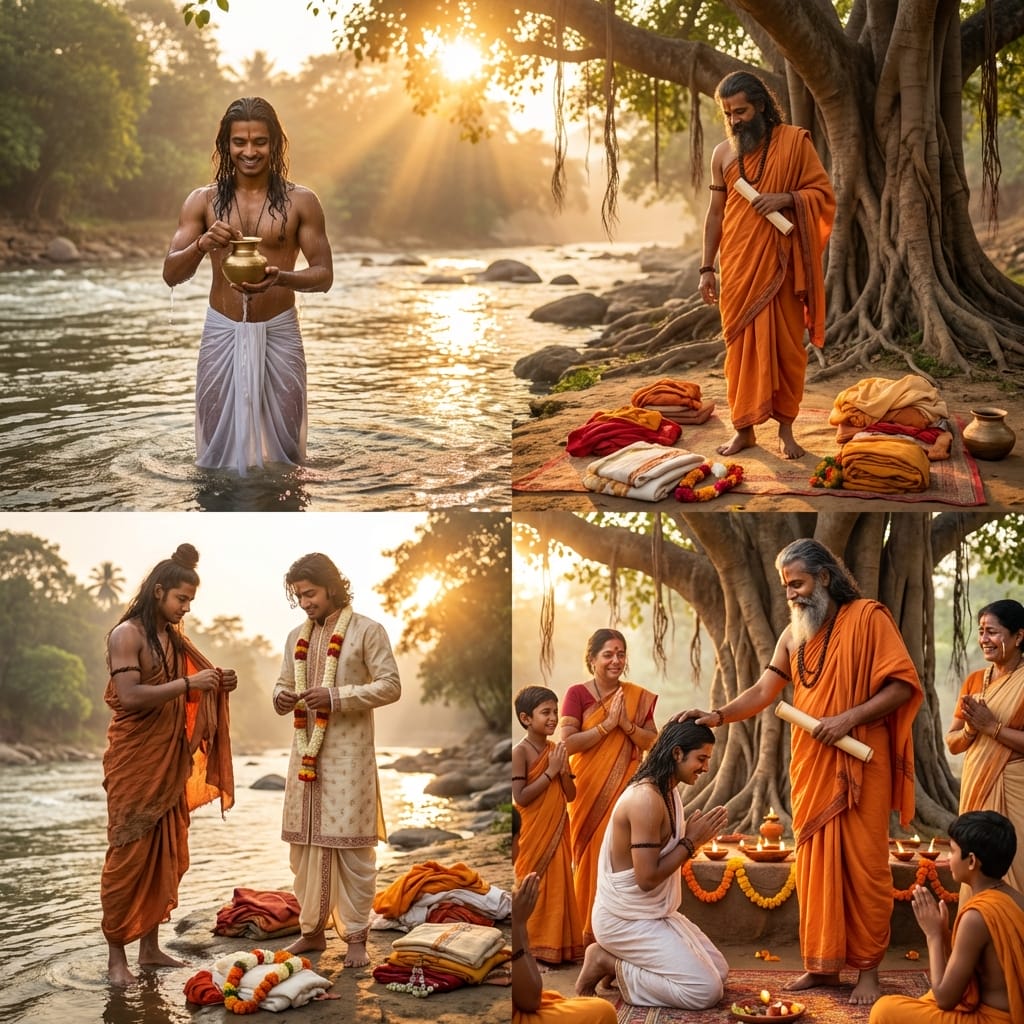
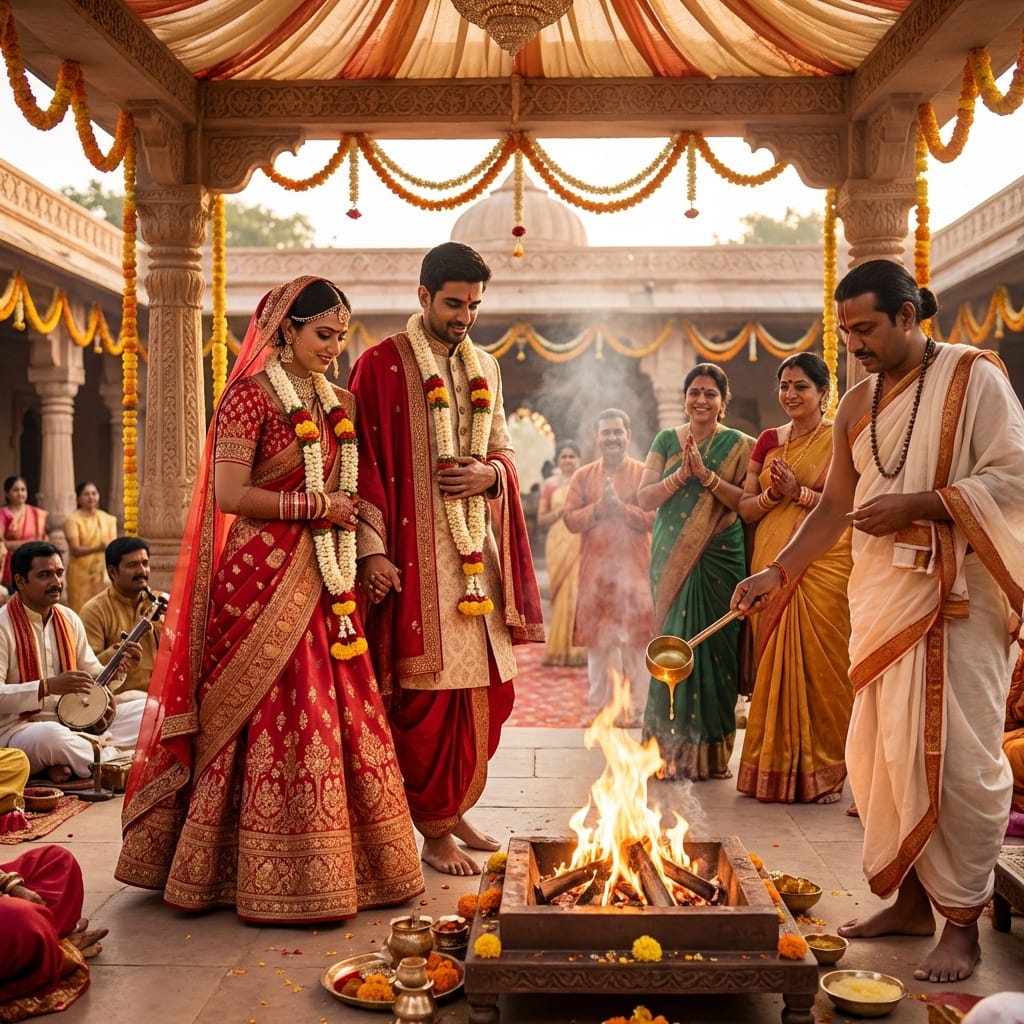
About Vedarambha Sanskar - Beginning of Vedic Study Ceremony Guide
Vedarambha Sanskar - Beginning of Vedic Study Ceremony Guide के बारे में
Vedarambha Sanskar (वेदारम्भ संस्कार), meaning "Beginning of Vedic Studies", is the twelfth Sanskar marking the formal commencement of studying the four Vedas (Rigveda, Yajurveda, Samaveda, Atharvaveda) and related scriptures. Performed after Upanayana, this ceremony initiates intensive spiritual education under a guru's guidance.
The word "Vedarambha" comes from "Veda" (sacred knowledge) and "Arambha" (beginning). While Vidyarambha introduces basic learning and Upanayana confers spiritual eligibility, Vedarambha specifically focuses on advanced Vedic study—mantras, rituals, philosophy, and sacred texts that form Hinduism's foundation.
Traditionally, after Upanayana, the young brahmachari (student) would spend years in the guru's ashram mastering Vedic recitation, understanding commentaries, learning correct pronunciation (Vedic Sanskrit has precise phonetics), and absorbing the spiritual wisdom contained in these ancient texts.
The ceremony involves prayers to Goddess Saraswati (knowledge), receiving the guru's blessings to begin Veda study, and the student's commitment to learn with discipline, reverence, and complete focus. In modern times, while few pursue full-time Vedic scholarship, families perform Vedarambha symbolically or for children seriously interested in scriptural learning.
Science & Ayurveda Behind Vedarambha
वैज्ञानिक और आयुर्वेदिक आधार
The specialized Vedic education system has fascinating cognitive science parallels:
Oral Tradition & Memory Formation: Vedic learning emphasizes oral transmission—hearing, repeating, memorizing. Neuroscience shows that multi-sensory learning (auditory + vocal) creates stronger, more durable memories than passive reading alone.
Sanskrit & Linguistic Benefits: Learning Sanskrit, a highly structured language, enhances metalinguistic awareness. Bilingual and multilingual education is shown to improve cognitive flexibility, executive function, and even delay cognitive decline.
Rhythmic Chanting & Brain Synchronization: Vedic chanting involves complex rhythms and patterns. Research shows that rhythmic activities synchronize brain hemispheres, enhance attention, and promote relaxation through vagal nerve stimulation.
Intensive Study & Neuroplasticity: The rigorous, dedicated study environment of traditional Vedic schools creates an immersive learning experience that maximizes neuroplastic changes—the brain physically changes in response to intensive learning.
Guru-Shishya Transmission: One-on-one or small-group instruction with a dedicated teacher provides personalized pacing and immediate feedback—shown to be the most effective teaching method.
Memory Techniques: Vedic students used sophisticated memory techniques (paada-paatha, krama-paatha systems) to memorize vast texts. Modern memory science validates these spacing and chunking strategies.
Discipline & Self-Regulation: The structured brahmacharya lifestyle develops self-regulation, a key predictor of academic and life success. Research shows structured routines and delayed gratification improve executive function.
Meditation & Cognitive Benefits: Traditional Vedic study included meditation practices. Extensive research shows meditation reduces stress, improves attention span, enhances emotional regulation, and promotes overall wellbeing.
Gurukul System & Oral Tradition
गुरुकुल प्रणाली और मौखिक परंपरा
The Vedas are humanity's oldest scriptures, preserved for over 3000 years through oral tradition before being written. Vedarambha initiated students into this sacred lineage of knowledge transmission. The guru-shishya (teacher-student) relationship was central—knowledge wasn't just read from books but absorbed through living with and serving the guru.
Correct pronunciation is crucial: Vedic mantras are believed to lose power if mispronounced. Students underwent rigorous training in Vedic phonetics (Shiksha), learning exact sounds, accents, and rhythms. This precision preserved the Vedas unchanged across millennia.
Different Vedic schools (Shakhas) emerged, each specializing in particular Vedas with slightly varying recitation styles. A student joining a specific Shakha would master that tradition completely. This diversity within unity enriched Vedic scholarship.
The study wasn't purely academic—it was transformative. Students learned not just mantras but their meanings, applications in rituals, philosophical insights, and how to live Vedic principles. This holistic education aimed at character development, not mere information transfer.
Vedarambha Ceremony Elements
वेदारम्भ के तत्व
Guru Selection
गुरु चयन
Student (or family) identifies a qualified guru proficient in the Veda branch to be studied. Traditional gurus were those who had mastered their lineage and could transmit knowledge properly.
Saraswati Puja
सरस्वती पूजा
Worship Goddess Saraswati seeking blessings for successful Veda learning. Student offers prayers for sharp memory, understanding, and devotion to sacred knowledge.
Guru Vandana
गुरु वंदना
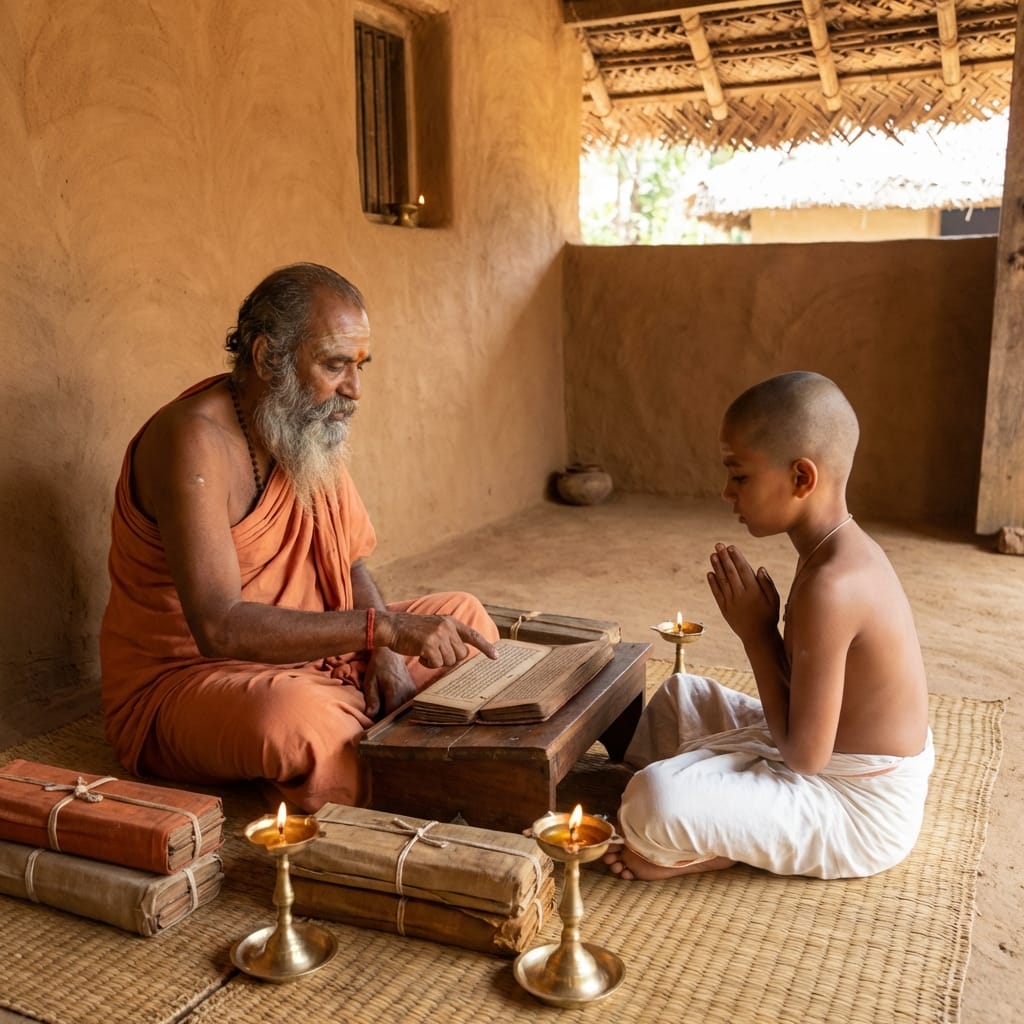
Student seeks guru's permission and blessings to begin Veda study. Makes formal commitment to learn with discipline, obedience, and respect for the tradition.
First Vedic Lesson
प्रथम वेद पाठ
Guru teaches the first Vedic verse or mantra. Student repeats it carefully, marking the beginning of their Vedic education journey.
Vedarambha Ritual Steps
वेदारम्भ विधि चरण
Why It Matters
यह महत्वपूर्ण क्यों है
Vedic Preservation – Continues the ancient tradition of passing Vedic knowledge to next generation, preserving humanity's oldest scriptures.
Spiritual Depth – Initiates systematic study of profound spiritual wisdom contained in Vedas, enabling deeper understanding of dharma.
Guru-Shishya Bond – Strengthens the sacred teacher-student relationship essential for traditional knowledge transmission.
Character Development – Vedic study isn't just academic—it transforms character, instilling discipline, humility, and righteousness.
Cultural Heritage – Connects student to 3000+ years of continuous spiritual tradition and Sanskrit scholarship.
Ritual Competence – Enables student to eventually perform Vedic rituals correctly and guide others in spiritual practices.
What's Inside
इसमें क्या है
- Complete Ceremony Process – How Vedarambha is performed
- Four Vedas Overview – Brief introduction to Rig, Yajur, Sama, Atharva Vedas
- Guru-Shishya Tradition – Sacred teacher-student relationship explained
- Vedic Recitation Basics – Importance of correct pronunciation
- Modern Adaptations – Part-time Veda learning while in regular school
- Study Duration – How long traditional Vedic education took
- Lineage Importance – Why guru parampara (succession) matters
Frequently Asked Questions
अक्सर पूछे जाने वाले प्रश्न
Is Vedarambha still relevant in modern times?
Yes, though adapted. While few pursue full-time Vedic scholarship as in ancient Gurukuls, many families perform Vedarambha for children learning Vedic chanting at temples/traditional schools. It creates reverence for scriptures and connects youth to heritage. Some dedicated students still undertake serious Veda study alongside modern education. The ceremony remains valuable for anyone beginning systematic scripture learning, even if part-time.
Which Veda should one study first?
Traditionally determined by family lineage and guru's specialization. Generally: Rigveda is oldest and foundational (hymns), Yajurveda for rituals (procedures), Samaveda for musical chanting, Atharvaveda for practical applications. Modern students often begin with Yajurveda as it's most directly used in household rituals, or Rigveda for its philosophical depth. Guru advises based on student's aptitude and goals.
How long does Vedic study traditionally take?
Mastering a complete Veda traditionally took 12+ years of intensive daily study in a Gurukul. Students would memorize entire texts perfectly, learn meanings, and understand applications. Modern part-time study might take longer but covers less comprehensively. Basic competence in Vedic chanting for rituals can be achieved in 3-5 years of regular practice. Complete mastery remains a lifelong pursuit requiring dedication.
Can females undergo Vedarambha and study Vedas?
This is historically debated and varies by tradition. Ancient times had female scholars (Gargi, Maitreyi) who studied Vedas. Over time, restrictions emerged in some communities. Modern progressive scholars and organizations support women's Vedic education, noting that knowledge is universal. Many contemporary Vedic schools teach women. It's ultimately a family/community decision, though the trend is toward inclusivity in learning.
Is it necessary to have a guru for Veda study?
Traditionally, yes—Vedic knowledge must be transmitted orally from guru to student for authenticity, correct pronunciation, and proper understanding. Books alone can't convey the subtle phonetics and meanings. However, in modern times where finding traditional gurus is difficult, people use audio recordings, online classes, and books as accessible alternatives. Ideal is combining these with at least periodic guidance from a knowledgeable teacher for corrections.
What's the difference between Vidyarambha and Vedarambha?
Vidyarambha (at age ~5) marks the general beginning of formal education—learning alphabets, basic reading, writing, arithmetic. Vedarambha (after Upanayana, age ~8+) specifically initiates Vedic scripture study—learning Sanskrit, mantras, Veda recitation, philosophy. Think of Vidyarambha as starting elementary school, Vedarambha as beginning specialized higher spiritual education. One is general literacy, the other sacred scriptural scholarship.
Scientific References & Citations
- The Sanskrit Effect: MRI Study — Scientific American
- Neuroscience of Chanting — National Institutes of Health (NIH)